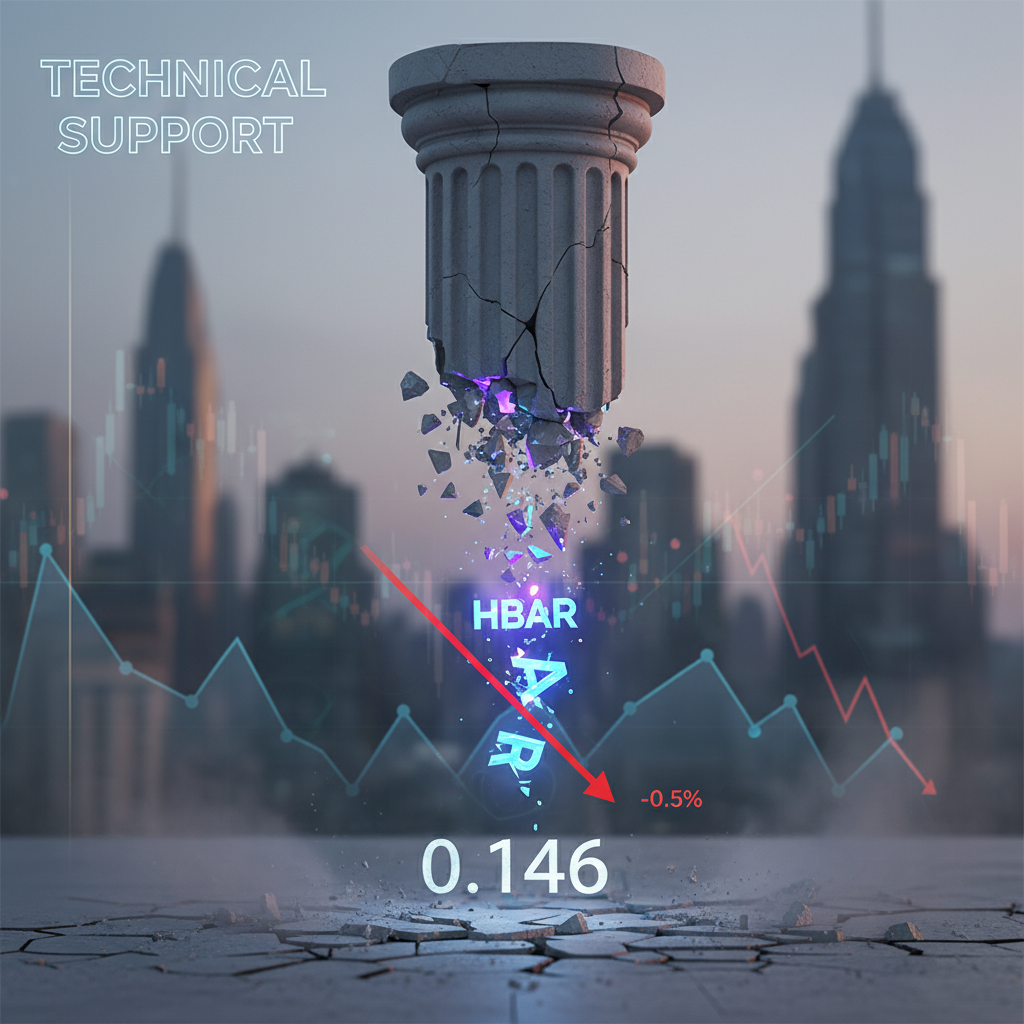

Hey crypto enthusiasts! Let's dive into some recent market chatter surrounding Hedera's native token, HBAR. If you have been keeping an eye on your portfolios or market charts lately, you might have noticed a slight tremor in HBAR's price action. It is not always about massive crashes or parabolic pumps; sometimes, even smaller movements can signal deeper shifts worth understanding. Recently, HBAR experienced a 0.5% slide, settling at a price point of $0.146, a move that, while seemingly minor, carried significant implications for its technical standing in the market.
So, what exactly does a 0.5% dip mean in the fast-paced world of crypto? On its own, a half-percent movement might not raise many eyebrows. However, the devil, as they say, is in the details, and in this case, the context is everything. This particular slide pushed HBAR below some critical technical support levels, accompanied by what analysts call 'elevated volume.' Think of it like a floor giving way a little, but with a lot of heavy foot traffic making the creak sound even louder. This combination often suggests that a significant number of market participants are actively engaging in selling.
The price of $0.146 might just be a number, but when key levels are breached, it triggers a chain reaction among traders and algorithms that pay close attention to such thresholds. For many, breaking support is a red flag, indicating that the path of least resistance might now be downwards, at least in the short term.
In the world of financial markets, technical analysis is a popular approach where traders look at historical price data and volume to predict future price movements. One of the most fundamental concepts here is 'support.' Imagine a price level where, historically, buyers have stepped in to prevent further price declines. It acts like a floor, holding the price up.
When a token like HBAR falls to a support level, it often bounces back. But what happens when that support crumbles? It signals a shift in market sentiment. It means that the buying interest at that level is no longer strong enough to counteract the selling pressure. For HBAR, the recent dip below crucial support suggests that the bulls, or buyers, are losing ground to the bears, or sellers. This can often lead to further price discovery downwards until new support is established.
“Breaking a key support level is not just a statistical blip; it often reflects a psychological shift among investors, indicating a potential weakening of confidence.”
Now, let us talk about 'elevated volume.' Price movements become far more significant when they are backed by high trading volume. If HBAR's price had slid by 0.5% on low volume, it might be dismissed as typical market noise or a small number of traders making moves. However, when the volume is elevated, it means a substantial amount of HBAR tokens changed hands during that price drop.
High volume accompanying a price decline suggests strong conviction behind the selling. It tells us that a large number of participants, potentially including big players, are actively choosing to exit their positions. This adds weight to the price action, reinforcing the idea that the break in technical support is a meaningful event, not just a momentary fluctuation.
Here is where things get particularly interesting, and perhaps a bit more complex: 'institutional distribution patterns.' This phrase points directly to the activities of large, sophisticated investors like hedge funds, asset managers, or even corporations that hold significant amounts of HBAR. When institutions 'distribute' their holdings, it means they are gradually selling off their tokens, often in a way that aims to minimize disruption to the market, but the collective effect can be substantial.
Why would institutions be selling? There could be several reasons:
The intensifying of these distribution patterns is what truly amplified the selling pressure on HBAR. When a whale starts to swim away, it creates ripples. When multiple whales start moving, they can create significant waves. Their sheer size and the volume of tokens they hold mean their selling activity has a much greater impact on price than individual retail investors.
For investors keeping an eye on Hedera, this recent price action is a signal to exercise caution and perhaps re-evaluate their positions. While a 0.5% dip might not sound dramatic, the underlying factors, namely the broken technical support and institutional distribution, paint a picture of increased selling pressure and potentially weakening short-term sentiment.
It is important to remember that crypto markets are inherently volatile, and price movements are influenced by a myriad of factors. A single day's price action does not define the long-term prospects of a project. However, understanding these signals helps investors make more informed decisions. Hedera, with its unique hashgraph technology and focus on enterprise adoption, has a strong fundamental case. But even strong projects are subject to market forces and the whims of large holders.
The coming days and weeks will be crucial for HBAR. Will new buyers step in to establish fresh support levels? Will institutional selling abate, or will it continue to exert downward pressure? These are questions that active traders and long-term investors alike will be pondering. Monitoring subsequent trading volume and price action around these new levels will provide further clues.
For now, HBAR's slight slide acts as a reminder that even robust projects are not immune to market dynamics, and understanding the interplay between technical indicators and institutional behavior is key to navigating the exciting yet unpredictable world of cryptocurrency.
.png)